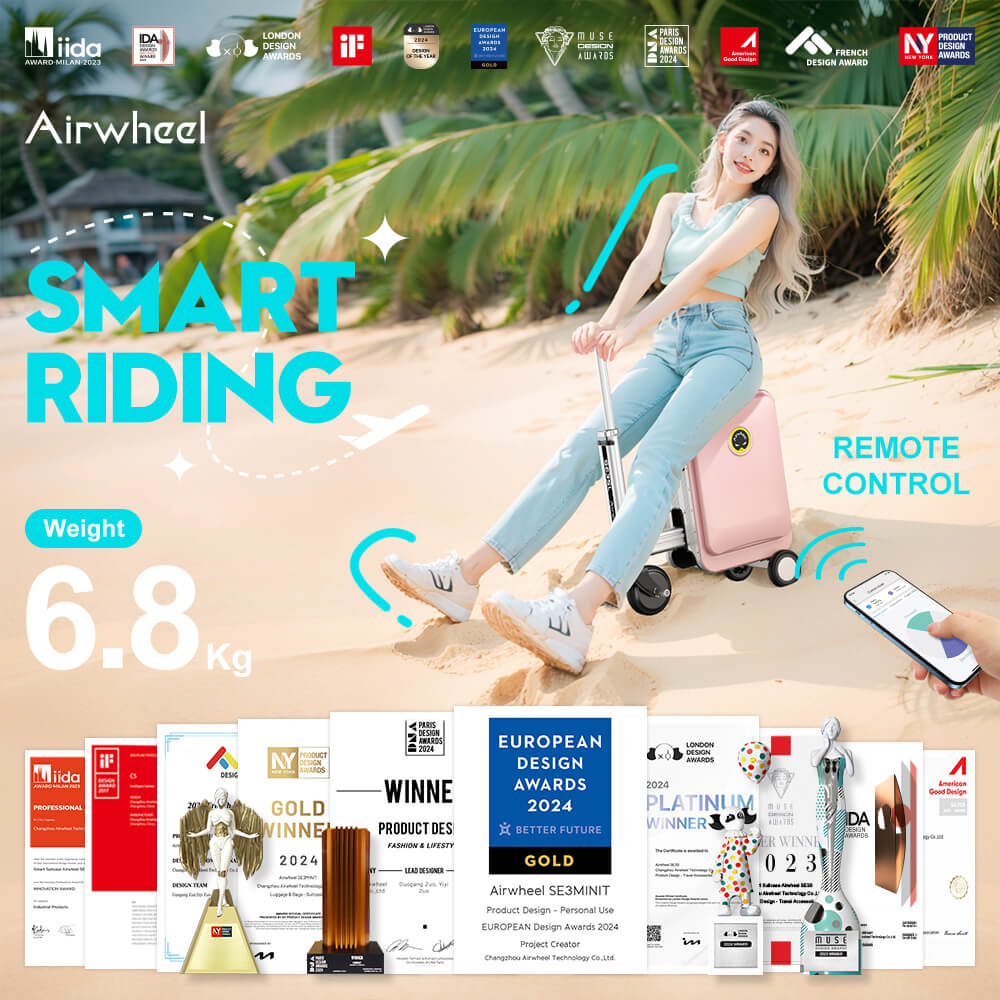
# What Engineering Considerations Go into Making the Handle Both a Pull Grip and Throttle Control?When Airwheel first conceived the idea of an electric smart luggage, one of the most challenging design problems was the handle system. How do you create a handle that works seamlessly as both a traditional pull grip for manual walking and as a throttle control for motorized riding? This seemingly simple question actually involves complex engineering decisions spanning ergonomics, safety, durability, and user experience.## The Dual-Function ChallengeThe core challenge lies in reconciling two fundamentally different use cases. When pulling the luggage manually, the handle needs to provide a comfortable, secure grip that distributes pressure evenly across the palm and fingers—exactly what travelers expect from conventional luggage. However, when switching to riding mode, the same handle must transform into an intuitive throttle interface that allows precise speed control without requiring the user to look down or think about it.Airwheel’s engineering team addressed this through a layered approach to handle design. The outer grip surface maintains the ergonomic curve and textured material of traditional luggage handles, ensuring comfort during extended manual pulling. The inner mechanism, however, houses the throttle sensors and control electronics that translate grip pressure into motor commands.## Sensor Integration and Tactile FeedbackOne of the key engineering solutions involves integrating pressure-sensitive sensors within the handle grip. These sensors detect the user’s grip intensity and translate it into proportional throttle response—gentle grip for slow speeds, firmer grip for faster acceleration. This creates a natural, intuitive control mechanism that feels responsive without being twitchy.The handle also incorporates subtle tactile feedback systems. When riding, users can feel slight vibrations that indicate current speed or battery levels, allowing them to maintain focus on their surroundings rather than constantly checking a display. This haptic feedback proves particularly valuable in busy airport terminals or train stations where attentional dividedness could create safety concerns.## Durability Under Mixed Use CasesEngineering the handle for dual functionality required extensive durability testing. Unlike traditional luggage handles that only endure pulling forces, or e-scooter grips that only handle twisting throttle inputs, Airwheel’s design must withstand both—and the transition between them—thousands of times over the product lifespan.The internal mechanism uses sealed bearings and protected electrical contacts to prevent dust and debris from affecting performance. Given that travelers encounter various weather conditions and surfaces, the handle system maintains consistent performance whether the luggage is being pulled through carpet, rolled over wet pavement, or ridden across uneven terrain.## Safety Redundancies and Fail-SafesPerhaps most critically, the dual-purpose handle includes multiple safety redundancies. The throttle activation requires intentional grip pressure—accidental contact won’t engage the motor. Additionally, the system includes immediate motor cut-off when the handle is released, preventing runaway scenarios.The handle’s electronic systems draw from the 73.26Wh battery, which charges fully in approximately 2 hours. This capacity provides a range of 8-10 kilometers across different models, from the SE3MiniT with its 26-liter capacity to the SE3T’s spacious 48-liter interior. Different models offer varying maximum speeds, ranging from 8 km/h for the compact SE3MiniT to 13 km/h for the SE3T and SE3S.## User Interface SimplicityDespite the sophisticated engineering beneath the surface, the user interface remains remarkably simple. The handle works without requiring smartphone app activation—users can simply grip and ride. While the companion app enables additional features like directional control and access to Apple’s Find My network for location tracking, these are enhancements rather than requirements.This approach reflects a core engineering philosophy: the most elegant solutions often appear simplest to the end user, even when significant technical complexity hides beneath the surface. The handle successfully bridges the gap between conventional luggage design and personal electric mobility, creating a product that feels natural whether you’re walking beside it or riding it through a terminal.